
If Your Job is Replaceable by AI, the Problem Isn’t AI
Why the future belongs to humans who can think


Two years ago, I tried ChatGPT and thought it was meh—not particularly special, not worth relinquishing my creativity and thinking to.
To me, it felt like a tool for lazy people.
As you’ve probably guessed correctly, I’ve had a change of heart.
And no, I don’t leave my creativity or thinking to it. I’ve used the thing to summarize my futures trading reports, tested it to see if it understands the doodles I draw for my X posts, and even asked it to generate mock-ups for my book cover before engaging my designer.
It can get pretty good at some things (before it starts hallucinating, of course).
And then there’s Grok. Here’s what it gave me based on a simple prompt:

Now, I didn’t write this to bog you down with my favorite picks of AI tools.
If you’ve used these things long enough, you should notice how they’re getting better at an increasingly alarming rate. And that’s the point.
Wait, alarming? Really?
Save that thought. I’m about to overload your brain with all the interesting things.
Why You Might Be Right to Be a Little Scared
Movies like Terminator have primed us to think:
AI evolution → AI consciousness → AI rebellion → humans extinct
On top of that, you may wonder: If AI can write, code, compose, draw, analyze, etc., what’s left of me?
Will I become irrelevant? Will it replace creatives? Will only the tech elites benefit?
To me, most of these questions are absolute bollocks.
If we’re being honest with ourselves, they stem partly from the fact that AI threatens the narrative of us humans being special due to our intelligence.
And naturally, we fear what we can’t predict or don’t fully grasp.
But fear is only an emotion; it bears no intrinsic relation to rational thinking at all.
You see, one remarkable fact is that an evolutionary process will naturally accelerate, and its products grow exponentially in terms of capability and complexity.
This is true of technological evolution as it is of biological evolution.
Computer scientist and futurist Raymond Kurzweil calls it the Law of Accelerating Returns, or LOAR, for short (it’s been the primary idea in at least three of his books).
Translation?
AI will invariably get better as technology advances and innovation scales.
Except we’re not on a linear trajectory here. We’re riding an exponential curve that makes Moore’s Law look like child’s play.
The reason this is true is something you and I can equally observe. Just look what AI can do now compared to the slop it was regurgitating some two years ago.
Admittedly, things are getting interesting. But still, I honestly don’t think AI will replace you. I’m here to show you why and why not.
My Twisted Take: Embrace the Robot Overlords
Punch a wall, scream into a pillow all you want, but one fact remains: the AI revolution isn’t coming. It’s already here.
Should you be scared?
Yup.
Especially if you have the intelligence of a cat.
Seriously, let’s get down to the fundamentals. How do we even define intelligence?
The four defining components are your ability to learn from information and experience, reason through complexity, solve problems creatively, and adapt to new situations.
So there’s also that element of adapting to new situations. Note it for me.
And what is artificial intelligence?
To keep things simple, let’s go with:
The simulation of human intelligence (or cognitive processes) in machines.
The adaptability piece I told you to note is your superpower. This now brings us to a few contrarian takes I hold on AI:
AI is undeniably the best thing that’s happened in recent decades.
Further advancements in this field are necessary.
AI shouldn’t turn you into a retard.
AI doesn’t hurt your creativity.
I know, I know, neo-Luddites will want to skin me alive on the first and second points.
As for the last two points, we can merge them and use less colorful language:
AI shouldn’t cripple your ability to think.
To be blunt, the output from any AI tool is a direct product of your creativity, skill, and imagination. It’s the classic GIGO principle: garbage in, garbage out.
The flipside is brilliance in, brilliance amplified.
And while I hate to sound poetic, here’s the real question:
Are you good enough to make AI as good as you?
AI doesn’t generate ideas from thin air. It takes the specific instructions you give it; shaped by your interests, expertise, and creative direction, and helps you implement them faster and better.
Your favorite chatbot—Claude, Gemini, you name it—only plays a probability game at its core.
You ask something, and it churns out whatever the “digital coin flips” running on its silicon brain determine is most relevant to your query.
So, the tool is only as useful as the person wielding it. That means it’s just as important to learn how to prompt it well (which I teach).
AI as Your Thinking Partner
Let’s drop the act. You probably use an AI tool to draft those emails, craft comments and replies on social media, or write your LinkedIn posts. And if you don’t, you definitely know someone who does.
Is it wrong? Is it right?
The truth is, it depends on how you use it. When you use AI thoughtfully, it doesn’t replace your thinking — it rewires it. That’s how it should be, at least.
You can start asking clearer questions, shape tighter ideas, and spot mistakes you used to overlook. That’s the part people miss: AI can sharpen your mind rather than soften it.
I’ll give you an interesting example from my own experience. I enjoy writing, and I’ve used Grammarly long enough to not need it as much as I used to as my proofreading and editing partner.
Why?
Because I fucking rock!
Those are the kinds of things it’d tell me. Without the colorful lingo, obviously.
Narcissism aside, I’ve been learning from its suggestions and recommendations. I’m confident to say the tool somehow made me better, not dependent. And that’s the whole point.
But here’s the kicker: AI can sound incredibly confident even when it’s dead wrong (pretty much the Dunning-Kruger effect, only with a computer-ish twist).
And funnily enough, it’s contagious. You, too, can feel like a god shooting lightning from your fingertips while the bot feeds you utter nonsense. I’ll also cover this in another post, plus dozens of other ways wrongful use of AI can make you dumb. So stay tuned.
That said, I maintain that no AI tool should think for you. It should think with you.
You are the boss, and your job is to make it the ultimate sparring partner that challenges your ideas, refines your language, and forces you to bring your absolute A-game.
Why AI Won’t Actually Replace You
The most rudimentary lifeforms, even the tiniest bacteria and archaea, are capable of self-preservation.
But every piece of technology we build, no matter how advanced, will almost always depend on humans for purpose, direction, and accountability.
So will a clanker replace you?
Fuck no!
Not because someone needs to reboot the servers, but because AI has no agency of its own. It doesn’t want your job or your life or your future.
The objective truth is, AI is just a tool. Powerful as hell, yes, but a tool nonetheless. Not some rival. Not a substitute.
And what do we do with tools?
We use them to accomplish specific tasks by extending our abilities.
Think about it. Humans can make decisions in ambiguous, messy situations, yet we suck at processing massive volumes of data or organizing scattered, disconnected thoughts without wanting to jump off the building.
Computers, on the other hand, can crunch numbers so fast and sort information efficiently based on the instructions you give them.
Yet, machines and AI in general can’t understand the world as we do. They rely on statistical correlations, pattern recognition, and rules-based logic.
Let’s not forget that these things require training data and depend on human-defined objectives. And unlike us, they struggle with novelty and nuance.
Think about that for a moment. It’s why I’m convinced the most valuable technologies won’t be those that replace people. They’ll be the ones that empower people by replacing tasks.
Right now, the most important task we’re faced with is thinking about how we think alongside smart systems that help us with the thinking itself and handle the boring, repetitive shit so we can focus on what really matters.
You can now use AI to:
Summarize reports
Generate marketing images
Search the web with context
Refine and optimize your resume
Create personalized learning plans
Draft contracts and legal documents
Write and reply to posts on X (still cringe as fuck)
Critique your work and suggest improvements
Analyze spreadsheets and find patterns in data
And honestly, I can’t exhaust the list.
The question from earlier, “Are you good enough to make AI as good as you?” becomes critical here. Because if you can’t direct the tool effectively, you’re competing with it instead of leveraging it.
The Adaptation Game & How to Win It
In any technological revolution, it’s best we gobble down new knowledge and develop higher-level skills.
Those who adapt faster and transition to new and improved methods of doing things achieve better results.
The degree of task perception also evolves. With better tools, yesterday’s difficult tasks become the new easy. Near-impossible tasks become merely difficult.
And easy tasks? They become so insignificant that knowing how to handle them manually is fucking pointless.
So stop competing where artificial intelligence excels. You won’t out-calculate a computer. Instead, double down on what makes you irreplaceably human. Things like creativity, intuition, sound judgment, emotional intelligence, and strategic thinking.
This connects back to those four components of intelligence we talked about earlier. AI nails learning and problem-solving (to a degree). But adapting to genuinely novel situations, like those requiring ethical judgment or emotional nuance—that’s still our domain.
Furthermore, in order to thrive, we must invest in skills AI can’t easily replicate, like complex problem-solving in ambiguous situations.
I’ll use the prime example of radical innovation and scientific synthesis. The “Zero-to-One problem,” if you like.
Where we’re to identify a viable, market-changing solution to a previously undefined or poorly understood challenge, AI will struggle terribly.
Why?
That’s one thing that requires abductive reasoning and intuition.
AI is superb at two things:
Interpolation — finding patterns in existing data
Extrapolation — projecting those patterns
But true innovation requires abduction: forming a completely new hypothesis that explains the data in a novel way.
It could mean connecting two disparate fields to solve a problem, a feat currently reserved for human curiosity and multidisciplinary synthesis.
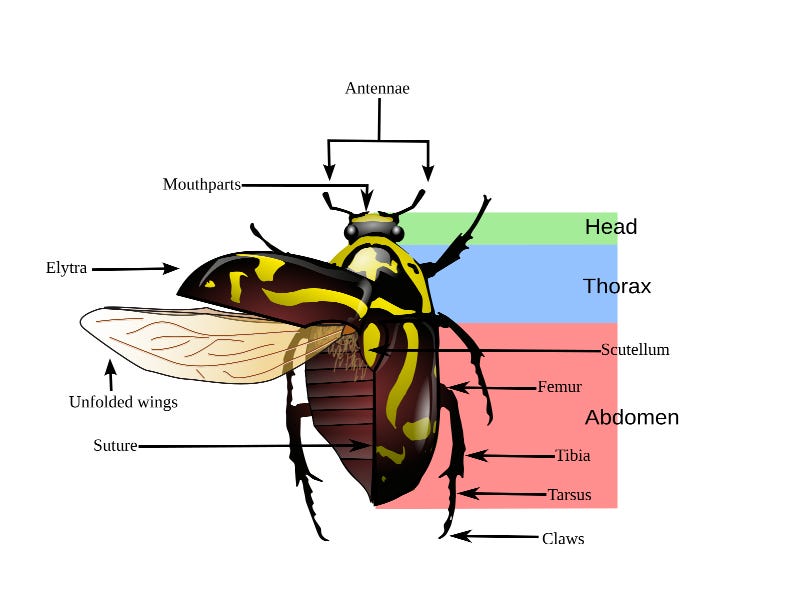
To see this in action, look at the Elytra Filament Pavilion.

German architect Achim Menges led the creation of this marvelous structure, all inspired by the hardened wing casings of flying beetles, known as elytra*.
The design copies the beetles’ ability to create a lightweight but strong and resource-efficient structure using a fibre composite material called chitin.
The pavilion itself uses glass and carbon fiber-reinforced plastics that were robotically woven into segments.
Below is an image of a fiddler beetle showing various parts, including the hardened wing casing similar to the one that inspired the design:
Interesting, right?
I don’t see AI achieving such levels of ingenuity yet.
That said, the professionals who thrive will be those who use AI to amplify their expertise while remaining uniquely human.
If your job can be described in a simple algorithm, it’s likely living on borrowed time. But if your work requires creativity, imagination, empathy, or strategic thinking, you’re golden.
*Elytra refers to the hardened forewings of the beetles, not the beetles themselves. The singular form of the noun is “elytron”.
Conclusion: Human Creativity + Machine Capability = Magic
I’ll end it by saying: the most profound innovations won’t come from AI alone or humans alone. They’ll emerge from the synergy* between human creativity and machine capability.
So far, I’ve talked about how AI is an exponential force, and the real threat isn’t the machine; it’s the person who refuses to evolve.
To win, you must stop competing where machines excel (competition is for losers). Instead, focus on becoming the ultimate director of the tool.
Now, don’t get me wrong. This is not about becoming an AI expert. It’s about staying relevant and sane in a world where the rules are being rewritten faster than we can read them.
Remember my journey from “meh” to “change of heart”? That’s the trajectory you’re on, whether you like it or not. The only question is whether you’re adapting fast enough to ride the wave or are about to drown in it.
The choice, as always, is yours.
— Ed
*I fucking hate the word “synergy” because it reminds me of the ChatGPT vomited corporate gibberish on the blue corporate app, the professional circus that is CringedIn.
If you liked this letter, here’s what you can do:
Subscribe for free to stay ahead.
Share your thoughts in the comments — I genuinely want to know how you’re using AI or what scares you about it.
Restack this here, share it on X, or send it to that friend who’s convinced the clankers will soon stage a revolution.
In upcoming letters, I’ll teach you principles and share practical examples to help you use AI to handle tasks efficiently, save your time (and sanity), and improve your daily life and business.
I love this read, Ed. You've nailed the core anxiety.....that 'fear of God' people feel about AI coming for their livelihoods.
I was firmly in that critic's camp initially. The turning point was shifting my mindset from seeing it as a replacement to seeing it as a collaborator. The things that make us uniquely human as you mentioned... our intuition, emotional intelligence, and creative spark,aren't threatened ... they're amplified when we offload the tedious work to AI.
Sitting down to properly dissect and learn its uses has been a game-changer for me (my own results have multiplied). The narrative completely flipped once I started working alongside it... though not chat gpt .. Excited for you to teach the 'how'!
Thanks for writing this, it clarifies a lot. You totally nailed how important it is to adapt to AI, not fear it. So insightful!